
We help you find your way to sober living built on the one thing recovery leans on most, other people who understand.
Peer and sober support is the help people in recovery give and receive from others who have lived it themselves. It runs on shared experience rather than professional treatment, and research links it to stronger, longer lasting recovery. Hopeful Estates does not run meetings or support groups. We help you find your way to sober living, where this kind of support is part of everyday life.
Recovery is far easier with people beside you who understand. Call us at 201 292 0185 or reach out through our contact page, and we will help you find your way to a home that fits.
Recovery holds better when a person is surrounded by others who understand, because addiction thrives in isolation. Peer support works through connection: hearing your own struggle in someone else’s story, learning coping tools from people who have used them, and staying accountable to a community that has been where you are. That shared experience reaches people in a way professional advice alone often cannot.
The effect is well documented. Peer support has been shown to help people reach and maintain long term recovery, and studies link regular participation in support groups to better treatment retention and higher rates of lasting abstinence. Mutual aid groups are also the most commonly sought source of help for substance problems in the United States. The reasons are practical as much as emotional: connection reduces isolation, builds coping skills, and eases the depression and anxiety that so often ride alongside addiction.

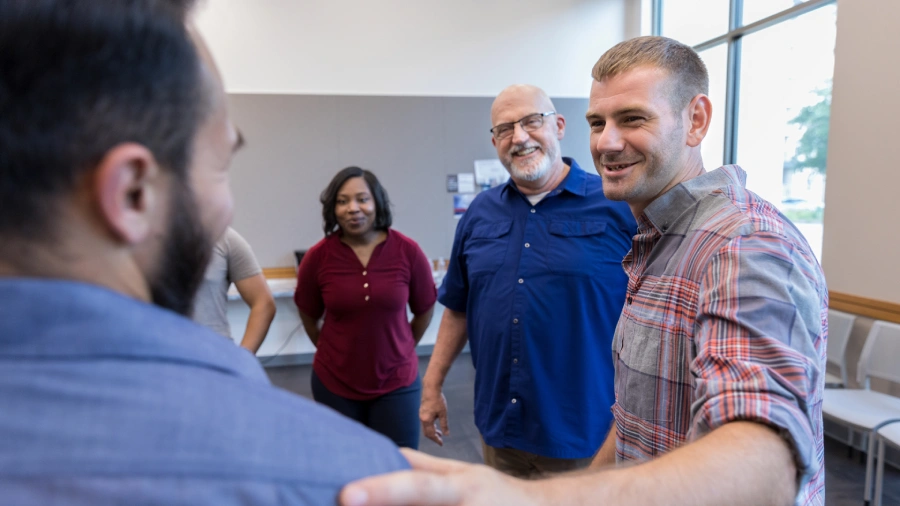
Peer support is not a replacement for treatment, and it works best beside it. Professional care, whether detox, residential, or outpatient, does important early work, but treatment alone is often not enough on its own to keep recovery going once formal care ends. Peer support fills the gap that opens when formal treatment ends and ordinary life begins. It extends the gains made in treatment into daily life, and it keeps a person connected during the vulnerable months when structure would otherwise fall away.
This is why peer support is so often described as aftercare. Research points to peer and mutual aid participation as a way to maintain treatment gains and stay engaged in recovery, at little or no cost and widely available almost everywhere. For many people, a support group or a sober community becomes the steady thread that runs from the end of treatment through the years that follow, long after the formal program is over.
Peer support comes in more than one form, and knowing the options helps you find the fit that works for you. The most familiar are mutual aid groups, peer led gatherings where members share experience and support each other. These fall into two broad families, and neither is better in the abstract. The right one is the one a person will actually attend.
| Approach | What It Is | Examples |
|---|---|---|
| Twelve step | Abstinence based groups built on a spiritual framework and shared steps, the most widely available option | Alcoholics Anonymous, Narcotics Anonymous |
| Non twelve step | Secular, skills based groups that focus on self management and evidence based tools, without spiritual language | SMART Recovery, Women for Sobriety, LifeRing |
Beyond organized groups, peer support also includes trained peer recovery specialists, sober friendships, and simply living among others in recovery. Each adds a layer of connection, and many people draw on several at once.
Peer and sober support and recovery coaching overlap, but they are not the same. Recovery coaching is one trained person working with you one on one toward your goals. Peer and sober support is broader, the wider community of groups, friendships, and shared living that surrounds a person in recovery. One is a focused relationship, the other is a network. Most people benefit from both, and you can learn more on our recovery coaching page.
A sober community turns peer support from something you attend into something you live inside. Researchers describe sober living as part of the social model of recovery, an approach where support comes from peers and shared daily life rather than clinical treatment alone. In a sober living home, that means waking up around others in recovery, sharing responsibility, and holding each other accountable, day after day.
This is what makes the setting so effective. The isolation that feeds addiction has little room to take hold when a person is surrounded by others working toward the same thing. Meetings and friendships help, and living inside a recovery community keeps that support constant rather than occasional.
We help you find your way to a recovery community that fits. Hopeful Estates helps people across New Jersey find sober living where peer support is part of daily life. We do not run groups, meetings, or homes ourselves. What we do is listen to your situation and connect you with sober living built on the shared experience that recovery leans on. Reach out and tell us where you are, and we will point you toward a home that fits. You can learn more on our sober living homes page.
You do not have to recover alone, and the right home surrounds you with people who understand. Tell us where you are and we will help you find sober living built on real peer support. Call us at 201 292 0185 or send a confidential message, and we will start today.
Peer support is help exchanged between people who share lived experience of addiction and recovery. It is non clinical, built on shared understanding rather than professional treatment, and research links it to stronger long term recovery.
Support groups are one form of peer support, but not the only one. Peer support also includes trained peer specialists, sober friendships, and living among others in recovery, with mutual aid groups like AA, NA, and SMART Recovery being the most familiar version.
Twelve step groups such as AA and NA are abstinence based and built on a spiritual framework, while non twelve step groups such as SMART Recovery are secular and focus on evidence based self management tools. Neither is better in general, the right fit is the one a person will keep attending.
Research supports it. Regular participation in peer support and mutual aid groups is linked to better treatment retention and higher rates of lasting abstinence, and these groups are the most commonly sought source of help for substance problems in the United States.
A recovery coach is one trained person working with you one on one, while peer and sober support is the wider community of groups, friendships, and shared living around you. Many people use both together.
Start with sober living, where peer support is built into daily life. Call us at 201 292 0185 or send a confidential message, and we will help you find your way to a home that fits your recovery.

Dr. Saquiba Syed is a board certified internal medicine physician based in Jersey City, New Jersey, affiliated with Jersey City Medical Center and other hospitals in the area. She earned her medical degree from King Edward Medical University and has more than 20 years of clinical experience in primary and hospital care. Dr. Syed reviews this page for medical accuracy.